
A 3 DOF robotic arm has three independent degrees of freedom that allow it to position its end effector within a defined workspace. It is commonly used in educational projects, prototyping, plotting, and basic pick-and-place applications where precise control of tool orientation is not required. This guide explains how a 3 DOF robotic arm works, compares it with a 4 DOF arm, explores pricing across different market segments, and shows where to find a free robot arm 3D model for design and simulation.
What is 3 Axis Robot Arm?
A 3 axis robot arm, also known as a 3 DOF robotic arm, uses three independent axes of motion to position its end effector. Depending on the mechanical configuration, these axes can be rotary joints, linear movements, or a combination of both. The arm can reach points within its workspace but cannot independently control the end effector’s full position and orientation.
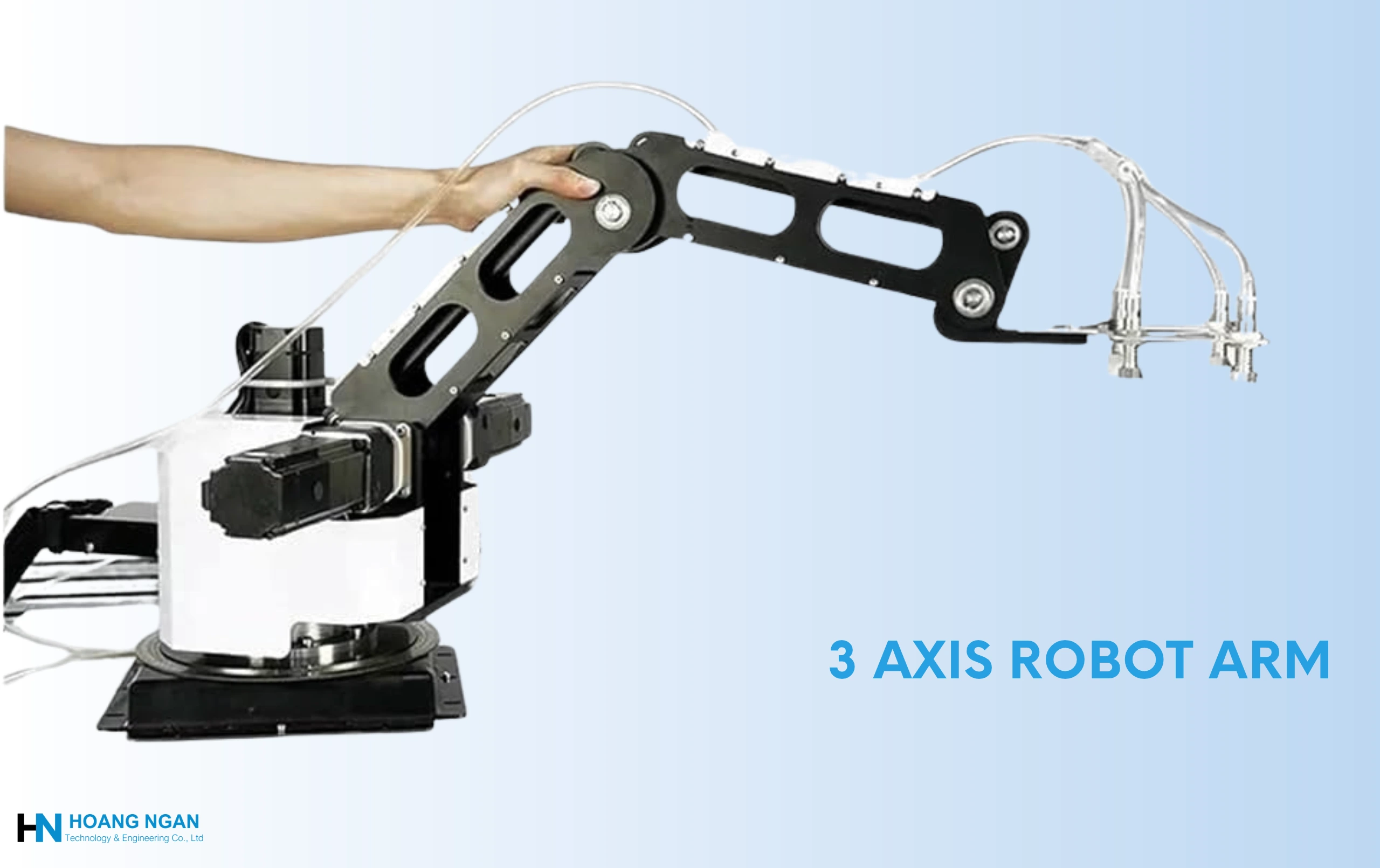
Common configurations include:
- Articulated (RRR): a rotating base, a shoulder and an elbow. This is the typical hobby and 3D printed layout.
- SCARA-style (RRP): two horizontal rotary joints plus a vertical slide.
- Cartesian (PPP): three linear axes, as in gantries and plotters.
- Delta (parallel): three arms driving one platform, used for very fast picking.
The most suitable configuration depends on the required workspace, payload, positioning accuracy, speed, and mechanical complexity.
3 DOF vs 4 DOF Robotic Arm
Choosing between a 3 DOF robotic arm and 4 DOF robotic arm depends on whether end-effector orientation (pitch or roll) is required for the application:
| Feature | 3 DOF arm | 4 DOF arm |
|---|---|---|
| Positioning | Depends on joint configuration; can provide X, Y, Z positioning | Can provide X, Y, Z positioning |
| Tool rotation | Limited by the three-axis configuration | An additional rotational axis may orient the tool |
| Best for | Basic pick-and-place, plotting, teaching, and simple handling | Assembly, screw driving, and applications requiring additional tool rotation |
| Complexity and cost | Generally lower for comparable systems | Generally higher for comparable systems |
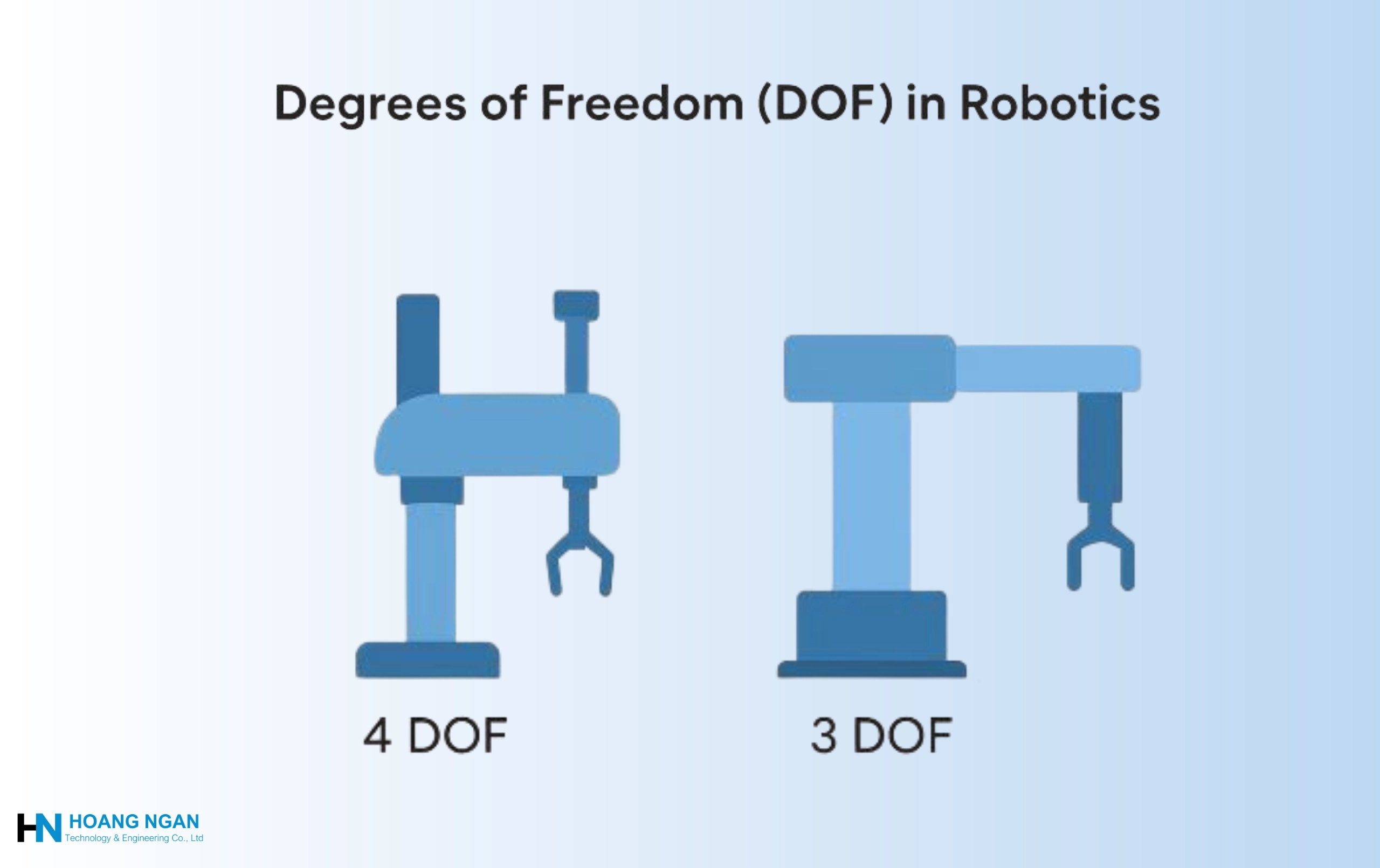
Choose a 3 DOF arm when the application requires positioning but does not need independent control of tool orientation. Examples include drawing, moving objects between fixed locations, and placing components into bins.
A 4 DOF arm is more suitable when an additional wrist rotation is necessary to align parts or orient a tool. However, the actual capabilities depend on the arrangement of the joints rather than the degree-of-freedom count alone.
For a closer look at four-axis industrial systems, see our guide to the SCARA robot arm.
3 DOF Robotic Arm Components
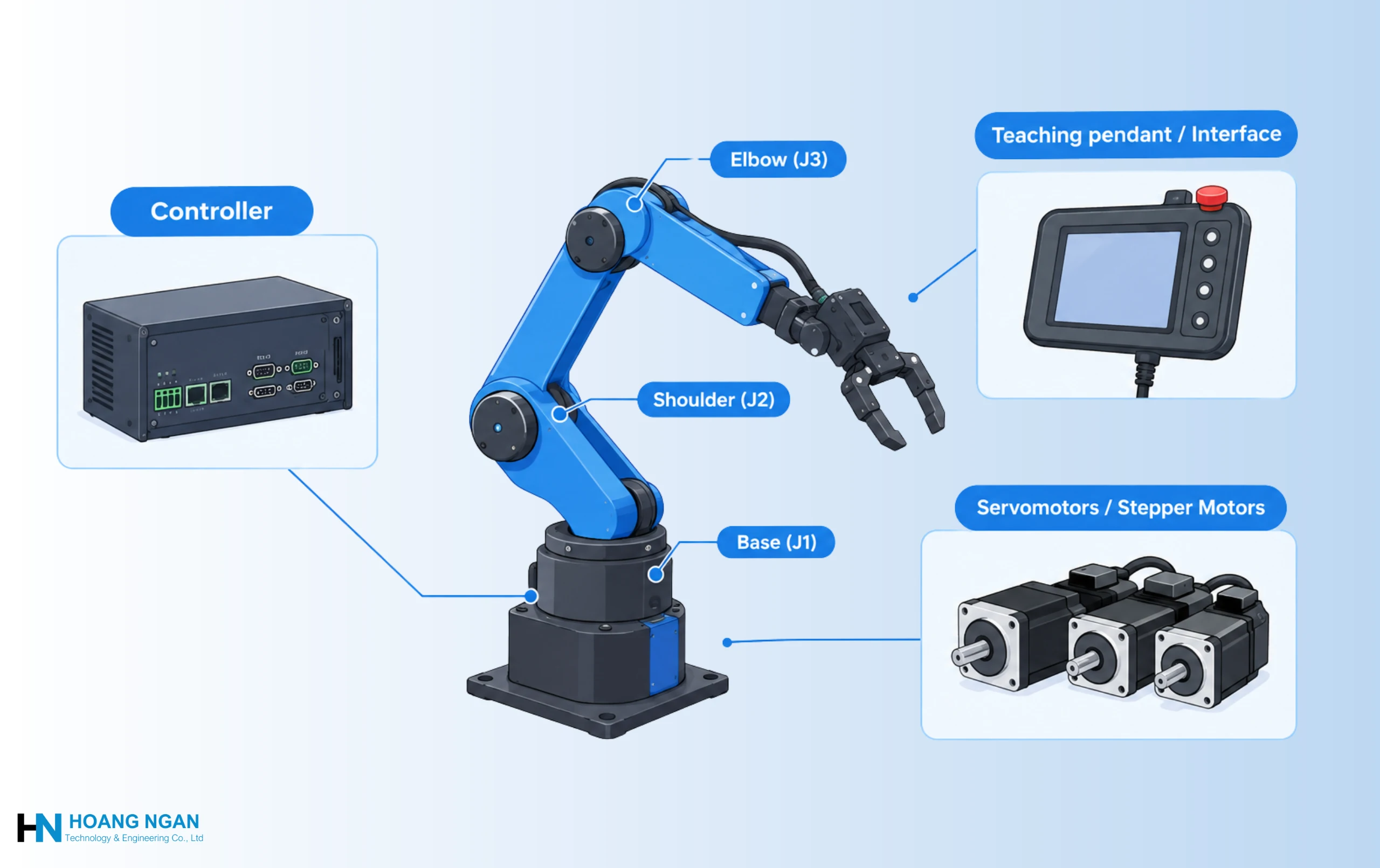
An industrial or desktop 3 DOF manipulator relies on three core operational modules:
Controller
The motion controller executes trajectory planning, processes inverse kinematics math, and communicates with motor drivers via EtherCAT, Modbus, or serial protocols.
Arm
Constructed from machined aluminum alloy or a lightweight 3d printed robot arm chassis, the physical manipulator houses high-torque servomotors, stepper motors, or harmonic drives to maintain high repeatability.
Teaching pendant or interface
Operators configure waypoints, calibrate origin offsets, and test sequences using dedicated software interfaces, mobile apps, or teach pendants.
3 DOF Robotic Arm Pricing
Pricing for a 3 DOF robotic arm varies based on load capacity, structural materials, precision drives, and intended usage:
European robot arm pricing
European manufacturers offer a wide range of industrial robots and automation systems, including articulated robots and collaborative robots designed for manufacturing, research, and material handling.
- KUKA & ABB: These manufacturers offer industrial robot portfolios for applications such as machine tending, material handling, assembly, and manufacturing automation. The $15,000–$30,000+ USD range in some industrial robot comparisons should be treated as a broad reference, not a verified price for a 3 DOF arm.
- Universal Robots & BCN3D: Universal Robots specializes in collaborative robot arms, while BCN3D Moveo is an open-source educational robotic arm project. These are different types of solutions and should not be treated as interchangeable 3 DOF products. The $8,000–$22,000+ USD range is an indicative reference for selected commercial robot systems, not a confirmed price range for BCN3D Moveo or 3 DOF arms.
For accurate pricing, confirm the model, number of axes, payload, controller, accessories, and installation requirements with the manufacturer or distributor.
Japanese robot arm pricing
Japanese brands serve as global benchmarks for motor control accuracy, sub-millimeter repeatability, and operational stability across electronics and automotive production lines.
- Yaskawa & FANUC: Both manufacturers provide industrial robot systems for handling, assembly, and production automation. The $12,000–$25,000+ USD range may serve as a broad reference for selected industrial robot packages, but it should not be interpreted as a verified price for a three-axis model.
- EPSON: EPSON offers SCARA robots and other automation products for high-speed assembly and pick-and-place tasks. Some configurations have four axes, so buyers should check the exact model and specifications before comparing them with a 3 DOF robotic arm. The $10,000–$20,000+ USD range is an indicative market reference rather than a confirmed price for all EPSON systems.
Actual costs vary according to model, payload, reach, controller, accessories, and regional pricing. Request a quotation for the specific configuration before making a purchasing decision.
Chinese robot arm pricing
Chinese brands offer flexible automation solutions, with prices typically 10–20% lower than comparable Japanese models while maintaining core performance. From SCARA robots to a 3 DOF robotic arm, these options help manufacturers reduce initial investment and accelerate their return on investment.
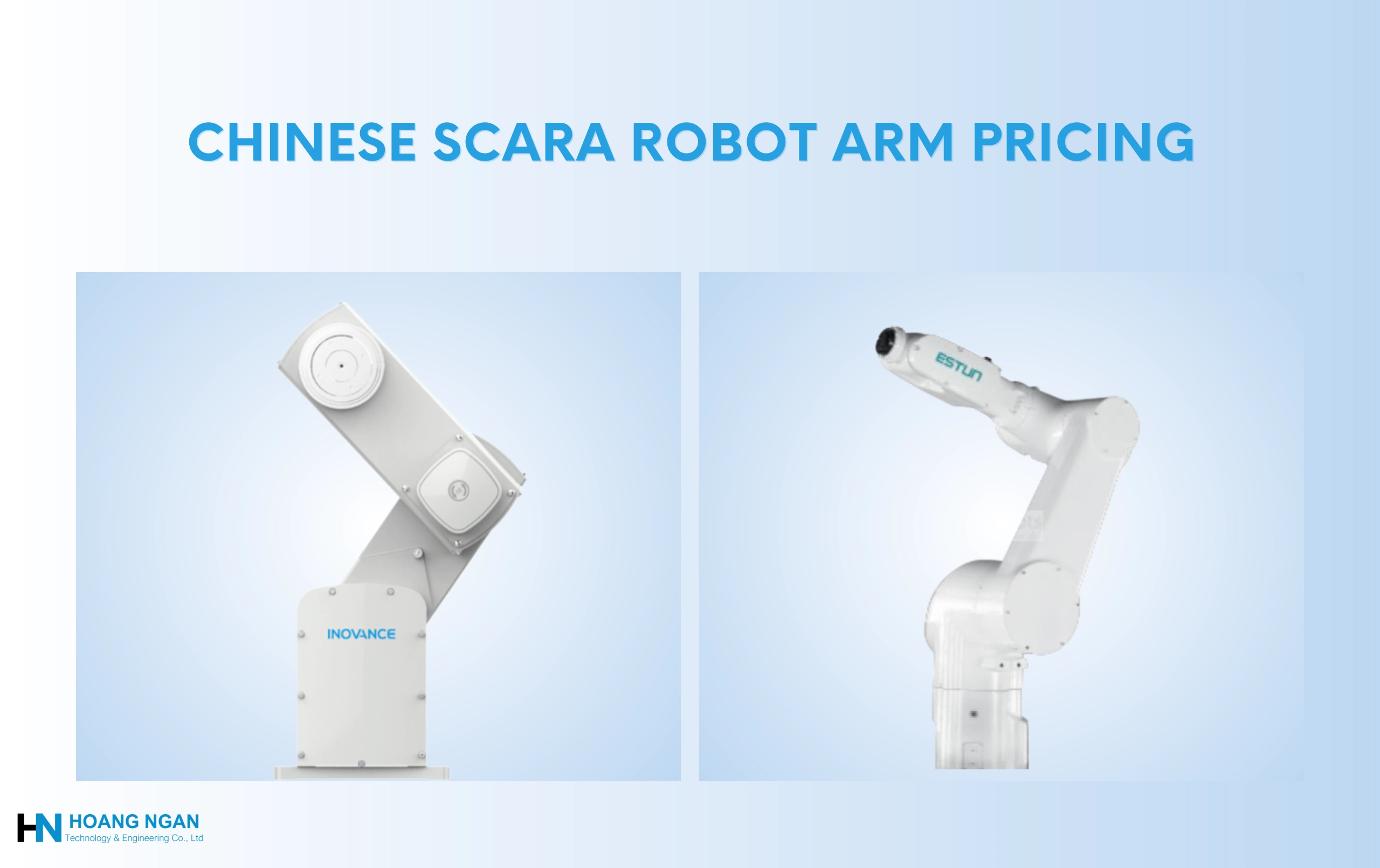
- Inovance: Inovance offers SCARA robots with payload capacities ranging from 4kg to 50kg across its product range. These robots support applications such as pick-and-place, assembly, and material handling. However, many industrial SCARA models have four axes and should not automatically be classified as 3 DOF robotic arms. For pricing and technical consultation in Vietnam, contact Hoàng Ngân TEC via Zalo OA or Hotline 0904.584.886.
- Estun: Estun provides SCARA robots with payload capacities ranging from approximately 3kg to 50kg across selected models. Its portfolio also includes mini and six-axis industrial robots for different automation requirements. These products can be alternatives for industrial applications, but the number of axes must be verified for each model before comparing it with a 3 DOF robotic arm. For pricing and technical consultation, contact Bình Dương AEC via Zalo OA.
Robot Arm 3D Model
A robot arm 3D model helps you check reach, mounting and clearance before you build or buy.
- Free models: for a robot arm free 3d model or robotic arm 3d model free download, start with open-source repositories. The BCN3D Moveo CAD and STL files are on GitHub. Always check each model’s licence before commercial use.
- Manufacturer CAD: for a KUKA robot arm 3D model or any major brand, check the maker’s download centre for STEP or CAD files, which are used for cell layout.
- SolidWorks: for a robot arm 3d model solidworks project, use native parts and assemblies so you can run motion studies and design grippers and fixtures around the arm.
Need CAD Models for Your Project?
Contact us for 3D CAD files (STEP, IGES, SolidWorks) and open-source CAD packages via Zalo OA or Hotline 0904.584.886! Our engineering team can provide official 3D STEP/SolidWorks files to help you integrate robotic arms into your cell design effortlessly!
Conclusion
Selecting a 3 DOF robotic arm depends on your workspace, payload, positioning accuracy, and budget. While 3D-printed arms are suitable for education and prototyping, Cartesian robots offer practical solutions for industrial three-axis positioning. For applications requiring greater flexibility, SCARA and six-axis robots from manufacturers such as Inovance and Estun may be suitable alternatives, depending on their configurations. If you need help selecting an industrial robot, comparing prices, or finding compatible 3D CAD models, contact Hoang Ngan TEC via Zalo OA or Hotline 0904.584.886 today to start your automation project


Trả lời